Suggested Family: A Versatile Font Collection for Bold, Striking Designs
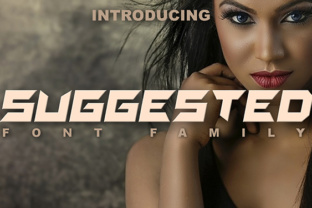
When selecting a typeface for a poster, flyer, or t‑shirt design, you are often looking for something that commands attention without sacrificing readability. The Suggested Family is a font collection designed to meet that need. It includes Regular, Italic, 3D, 3D Italic, 3D Filled, 3D Filled Italic, 3D Filled Gradient, and 3D Filled Gradient Italic styles. This range gives you a palette of options that can transform a simple headline into a visual focal point. Whether you are a freelance designer, a marketing professional, or someone working on a personal project, understanding what the Suggested Family offers and where it fits among other type choices can help you decide if it is the right tool for your next project.
What Makes the Suggested Family Distinct
Most font families offer a standard set of weights—light, regular, bold, and sometimes italic. The Suggested Family goes further by including multiple three‑dimensional variations. This is not merely a gimmick; the 3D styles add depth and layering that can make text appear to lift off the page or screen. The 3D Filled styles give the letterforms a solid, dimensional look, while the 3D Filled Gradient styles introduce color transitions within the fill, creating a polished, almost metallic or illuminated effect.
Because these styles are designed as a coherent family, you can mix and match them within a single composition without creating visual conflict. For example, you might use the Regular weight for supporting text and the 3D Filled Gradient for the main headline. This kind of flexibility is rare in decorative font families, which often consist of only one or two styles. The italics add an extra layer of dynamism, giving you the ability to suggest motion or emphasis without resorting to generic oblique versions.
Another distinct feature is that the 3D effects are built into the font files themselves. This means you do not need to manually create drop shadows, extrusions, or gradient overlays in your design software. The effect is applied as you type, saving time and ensuring consistency across letters. For designers working under tight deadlines, this can be a practical advantage.
How Suggested Family Compares with Other Decorative and Display Options
When evaluating the Suggested Family, it helps to consider the broader landscape of display and decorative typefaces. Many display fonts excel at being bold but offer only a single style, which limits their use in multi‑layered designs. Others, such as slab serifs or geometric sans‑serifs, provide multiple weights but lack the dimensional interest that the Suggested Family delivers out of the box.
Comparison with Standard Display Fonts
A standard bold sans‑serif can be effective for a headline, but it relies entirely on typographic hierarchy, spacing, and color to stand out. The Suggested Family, by contrast, brings its own visual texture. The 3D Filled Gradient styles, for instance, can reduce the need for additional graphic elements like background shapes or decorative borders. This can simplify your layout while still achieving a high‑impact look.
On the other hand, if your design calls for a minimalist or flat aesthetic, the dimensionality of the 3D styles may feel out of place. In such cases, a clean sans‑serif or a simple serif might serve you better. The Suggested Family is not designed for every context; it shines where boldness and depth are valued.
Comparison with Hand‑Lettering and Custom Typography
Custom hand‑lettering can produce unique, one‑of‑a‑kind results, but it is time‑consuming and requires specialized skills. The Suggested Family offers a middle ground: the look of dimensional lettering without the need to draw each character. For projects like event posters or promotional t‑shirts, where you need to produce text quickly and affordably, the Suggested Family can deliver a custom‑feeling result with minimal effort.
However, if your project demands absolute uniqueness—such as a logo for a brand that needs exclusive typography—a custom solution may still be preferable. The Suggested Family is a tool for efficiency and consistency, not for creating truly bespoke letterforms.
Strengths
- Built‑in dimensionality: The 3D, 3D Filled, and 3D Filled Gradient styles give you depth without extra software work.
- Style variety within one family: Having eight distinct styles allows you to create layered typographic compositions that feel cohesive.
- Time efficiency: Effects that might take minutes or hours to apply manually are already part of the font.
- Readability at large sizes: Because the family is designed for headlines and posters, letterforms remain clear even when scaled up.
Tradeoffs
- Limited use at small sizes: The 3D effects can become muddy or cluttered when the font is used in body text or at small point sizes.
- Stylized appearance: The dimensional styles carry a specific aesthetic that may not suit formal, corporate, or minimalist projects.
- File size and performance: Fonts with built‑in gradients and 3D effects can be larger than standard fonts, which may affect web loading times if used as webfonts.
- Less versatility for extended text: This is not a family designed for long paragraphs. It works best in short, impactful phrases.
When the Suggested Family Is the Right Choice
The Suggested Family is a strong candidate when your project needs to capture attention quickly. Examples include:
- Posters for events: Whether it is a concert, festival, or conference, the 3D styles can make event names and headliners pop.
- Flyers and promotional materials: When you have limited space and need to convey a message fast, the visual weight of the Suggested Family helps.
- T‑shirt and merchandise design: The dimensional styles work well on apparel because they read clearly from a distance and add a tactile feel to the design.
- Social media graphics: In a crowded feed, a headline set in 3D Filled Gradient can stop the scroll.
If your goal is to create a design that feels energetic, contemporary, and slightly playful, the Suggested Family is worth considering. The variety of italics also allows you to imply movement or direction, which is useful for action‑oriented messaging.
When You May Need Another Option
Despite its strengths, the Suggested Family is not a universal solution. You may want to look elsewhere if:
- You need a font for body text or long reading: The decorative nature of the family makes it unsuitable for articles, reports, or any text that requires extended reading.
- Your project demands a conservative or professional tone: For legal documents, corporate annual reports, or formal invitations, a classic serif or neutral sans‑serif is likely a better fit.
- You are designing for small screens or low resolution: The fine details in the 3D and gradient styles may not render well on small mobile screens or in low‑resolution environments.
- You need a font with extensive language support: Some decorative fonts have limited character sets. Check the character coverage of the Suggested Family if you are working with multiple languages or special characters.
In these scenarios, a more utilitarian typeface would serve you better. The key is to match the font’s personality to the project’s purpose, rather than forcing a bold style into a context that does not need it.
Practical Decision Factors
To decide whether the Suggested Family is right for you, consider these factors:
- Project context: Where will the design appear? If it is primarily in print at large sizes (posters, signage, apparel), the 3D effects will be an asset. If it is for digital use at multiple sizes, test how the font performs at smaller scales.
- Brand identity: Does the brand have an existing visual language? The Suggested Family works well with modern, creative, or youth‑oriented brands. For established, traditional brands, it may feel out of character.
- Time and resources: If you need to produce a design quickly and cannot invest in custom lettering or complex effects, the Suggested Family provides a ready‑made solution.
- Complementary typefaces: Think about what other fonts you might pair with it. A neutral sans‑serif or a simple serif can balance the boldness of the Suggested Family, giving your layout a clear hierarchy.
Realistic Examples of Use
Imagine you are designing a poster for a music festival. You set the festival name in the 3D Filled Gradient style, which gives it a vibrant, layered look that suggests energy and excitement. Below that, you use the Regular style for the date and location, and the Italic for the tagline. The result is a cohesive layout where each element has a distinct role, but all belong to the same typographic family.
For a t‑shirt design promoting a sports event, you might use the 3D Filled style for the event name, making it appear solid and dimensional against the fabric. The sharp edges of the letters remain clear, so the text is readable from across a room. The italic version could be used for a dynamic “versus” or “challenge” subtext, adding a sense of motion.
In a social media graphic for a new product launch, the 3D Filled Gradient Italic style could draw the eye to the product name, while the Regular style provides supporting details. The gradient effect works especially well with bright brand colors, reinforcing brand recognition without needing additional graphic elements.
Making an Informed Choice
The Suggested Family is a distinctive tool in the typographer’s kit. It offers a combination of styles that few font families provide, especially in the realm of built‑in 3D and gradient effects. For designers working on projects where impact and speed are priorities, it can save time and deliver results that stand out.
At the same time, it is not a replacement for all other typefaces. Understanding its strengths—bold dimensionality, style variety, and efficiency—as well as its limitations—small‑size readability, stylistic specificity, and suitability for long text—will help you use it where it serves the project best. By matching the font’s character with the project’s goals, you can make a thoughtful decision that balances creative ambition with practical needs.
Whether you are comparing display fonts for an upcoming campaign or exploring options for a personal design project, the Suggested Family is worth evaluating. Its range of styles gives you room to experiment without sacrificing consistency, and its built‑in effects let you achieve a striking look with less effort. Consider your audience, your medium, and your message, and you will know if this family is the right fit for your work.